Gokanosho
Gokanosho: read a travel guide to Gokanosho in the mountains of Kyushu, refuge of the legendary Heike clan.
Gokanosho - Secret Hiding Ground of the Heike 五家荘
Johannes Schonherr
Kyushu is overwhelmingly rich in sites related to Japanese history, legends and the myths of the Shinto gods.
Just step a little away from the modern highways, shopping centers and housing projects and you will discover the most amazing old tales related through shrines, temples, graveyards and ancient neighborhoods.
Even the most mundane roadside village, consisting at first glance of not much else than a few convenience stores and gas stations can turn into a treasure trove if you really start looking for the hidden historical sites it almost invariably possesses.
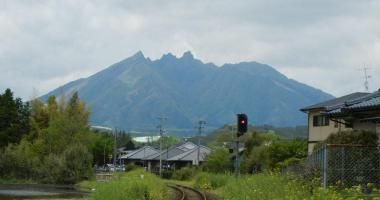
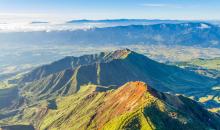
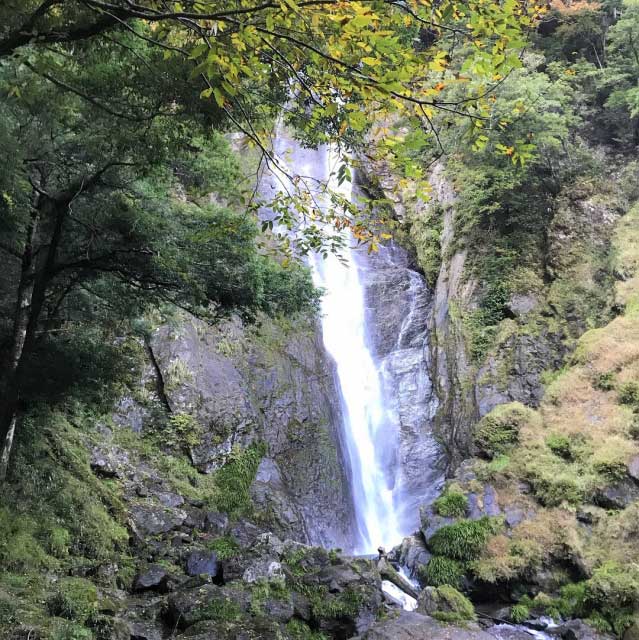
Welcome to Gokanosho (五家荘) in Yatsushiro City, Kumamoto Prefecture - in the deep center of Kyushu. The roads leading up here are indeed very narrow, very steep and very curvy. The mountains reach up to 1700 meters and the roads lead over passes as high as 1100 meters. In the winter, the whole area is accessible only by four-wheel-drive vehicles and older locals will tell you about that one winter when Gokanosho depended for a whole month on helicopter supplies because the snow was too deep for any ground transport to reach the area.
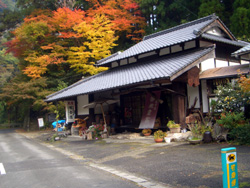
The villages are tiny and scattered over a wide area but most of them will have a minshoku (inn) where visitors can stay. In fact, in many cases, the inn will be the only large building in the village, usually also housing a small store and having a post box in front. Often the inn and the tool sheds attached to it are the village.
In the ancient times before there were things like paved roads these steep mountains were impossible to conquer by any sizable army. This has made them an ideal hiding place - and in this case the final hiding place for a once very powerful clan closely associated to the royal court in Kyoto.
The Heike
The Heike Clan was among the most powerful families in Japan in the 11th and 12th century. They were sophisticated, intermarried with the imperial family and had one of the highest standings any clan could have.
Politics at the royal court could turn nasty however. The extreme politeness displayed in Kyoto life could often barely hide the rivalry of the clans. Their bloody battles for influence took place elsewhere.
One of the most famous and most violent clan rivalries in the late Heian Period took place between the powerful and highly cultured Heike Clan, originating from Western Japan and their more rough-hewn competitors from the Genji Clan, originating in Eastern Japan. Both were part of the Imperial Court and the Heian times were basically peaceful times. But these two families could just not stop feuding.
Initially, the Heike easily won all those battles fought in remote locations. Who could beat any family as highly sophisticated and powerful as the Heike after all? They were skillful masters of the arts - both on the battlefield and in creating elaborated artistic masterpieces meeting the highest standards of the royal court.
But then, a new, fierce generation of Genji warriors rose up. They famously devastated the Heike during the Genpei War (1180-85), finishing them off in battles near Takamatsu, Shikoku (February 1185) and especially off the coast of Shimonoseki, in present-day Yamaguchi Prefecture (in March 1185).
With those defeats, the Heike became a hounded group. The Genji killed anyone associated with the Heike they could find. The surviving Heike fled to the most remote areas available for refuge - the mountains of Gokanosho becoming one of their main hiding grounds. The sophisticated aristocrats used to the luxury of the Imperial court had to adjust to a secret life in the mountains among the bears and wild boars. They never made a comeback in real life.
Heike Legacy
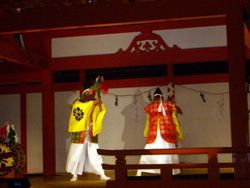
In Japanese legends, Noh plays, songs, ghost stories and novels, however, the tragic fate of the Heike has left an enduring legacy. The best experience perhaps of this legacy in Gokanosho is the kagura at Heike no Sato (Heike Village), a performance space built in the design of a shrine.
Kagura are traditionally raunchy farmers' dances re-enacting ancient tales of the Shinto gods. Takachiho in Miyazaki Prefecture, not far from Gokanosho, is most famous for this type of kagura.
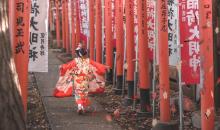
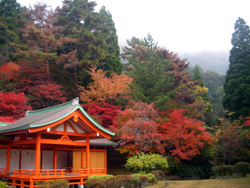
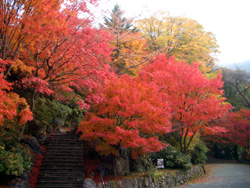
At Heike no Sato, however, the performances are of a rather somber type. The kagura is usually held in early to mid-November, the time when Gokanosho is in the midst of its intensely colorful autumn foliage. Burning torches light the nightly colors on the way to the open-air stage.
After the customary kagura dance designed to "clear the space for the gods," all further action is celebrating the sad fate of the Heike. Dances to songs bemoaning the Heike are performed by people from the village who may or may not be able to trace their ancestors right back to the old warriors of 800 years ago.
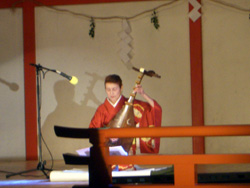
The main attraction for the past 20 years has been Tahara Junko, a singer famous for playing the biwa, the Heike lute, along to her rendition of the Heike Monogatari, the ancient poetic account of the battles that brought about the fall of the Heike clan.
Another event taking place in early November is the Kureko Kodai Odori, the strange, ancient dance of Kureko Village. It has recently been declared a national treasure.
Autumn Colors
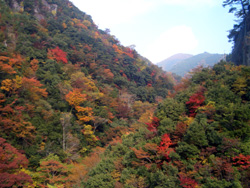
The intensity of the autumn colors proves today both a boon and a bane for Gokanosho. The leaves draw large numbers of weekend visitors from the bigger cities of Kyushu, namely Kumamoto and Fukuoka to the otherwise hardly traveled area. The inns rake in the money to survive the winter while serving freshly hunted boar and deer.
On the other hand, all those cars driving to the area clog the narrow mountain roads. Even large tourist busses try to squeeze their way through between the rocks and the guardrails. Prepare for a lot of backwards driving on steep mountain slopes if you head there by car in the high season. The buses will not be able to reverse with so many cars lined up behind them.
The Heike may be history but that doesn't make the mountains any easier to reach in the peak season.
Recently, Sundays offer a relief. All roads in Gokanosho are declared one-way on the first two Sundays of November. This might necessitate big detours but it helps the driving tremendously. Lots of locals are out as volunteers to enforce the temporary rules.
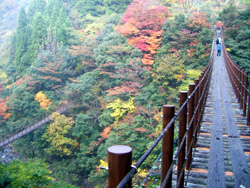
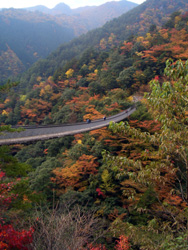
This system makes it quite easy to see and walk over the many spectacular suspension bridges leading over deep valleys with wild rivers far below, all surrounded by the brightly colored forests of the autumn season.
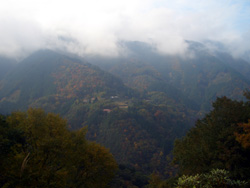
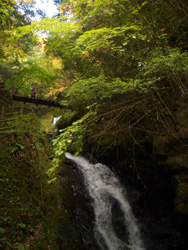
Fog might suddenly set in, sometimes with rays of sun breaking through. In these moments, Gokanosho really feels just like an ancient land of mythical legend.
Related Websites
Website of the Gokanosho area featuring many of the inns and giving information on events: www.gokanosyo.net (in Japanese)
Traveler site on Gokanosho with many pictures:
washimo-web.jp/Trip/Gokanosyo/gokanosyo.htm (in Japanese)
Traveler site on the Kureko dance with many pictures:
washimo-web.jp/Trip (in Japanese)
Text + images Johannes Schonherr
Gokanosho Access
Gokanosho is south east of Kumamoto city and east of Yatsushiro on route 445.
There are buses (90 minutes) from Hitoyoshi to Gokanosho at 7 am, 11.30 am and 3 pm.
Limited Express trains from Kumamoto to Hitoyoshi take 90 minutes and cost 2750 yen (2014).