Hiroshima Peace Park 広島平和記念公園

Hiroshima Peace Memorial Park
Fezbot2000 on Unsplash

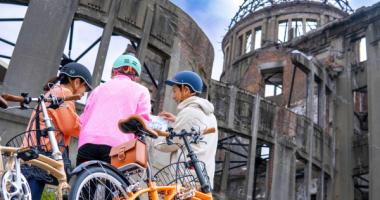
A-Bomb Dome in Hiroshima Peace Memorial Park
Caitlin James on Unsplash

Hiroshima Peace Memorial
Abdulaziz Alfawzan on Unsplash
The symbol of a national tragedy and now preserved as a peace memorial, dedicated to promoting peace and looking to a brighter future.
Peace Memorial Park
The history of Hiroshima and the world changed irrevocably at 8.15am on August 6 1945, when the US B-29 bomber "Enola Gay" unleashed the world's first atomic bomb attack on an inhabited city.
The 3m long, 4 ton "Little Boy" bomb dropped on Hiroshima carried 50 kg of uranium 235 and the fission of 1 kg of uranium released the equivalent of 16,000 tons of high explosive.
The city was leveled by the intense heat rays (which witnesses describe as creating a "second sun") and the huge blast, the combined force of which destroyed nearly all the buildings within a 2-3 km radius of the hypocenter, resulting in approximately 140,000 recorded deaths by December 1945.
Hiroshima's Peace Park is now listed as a UNESCO World Heritage site and contains a variety of memorials to the victims of that terrible tragedy in 1945.
Hiroshima's A-Bomb Memorials - A-Bomb Dome
Hiroshima's most recognizable symbol of the events of August 1945 is the A-Bomb Dome - the former Industrial Promotion Hall, built in 1914-15, and designed by acclaimed Czech architect Jan Letzel.
Although just 200 m west of the hypocenter of the nuclear explosion, the former Industrial Promotion Hall was one of very few buildings, along with the Former Bank of Japan Hiroshima Branch, to remain standing in a 3 km radius of the bombing. Parts of the concrete in the building were burnt and even melted, exposing the steel frame of the dome to the skies.
A little south of the Atomic Dome is the Memorial Tower to the Mobilized Students, dedicated to the more than 6,300 school pupils of the more than 8,000 in Hiroshima at the time of the atomic bombing who had been mobilized to clean up the city after conventional bombing raids. A recording plays in English and Japanese relating the story.
The majority of Hiroshima's peace momuments are a couple of minutes' walk further on, over the bridge, in Hiroshima Peace Park on the long, slim, delta island formed by the splitting of the Otagawa River into the Honkawa River to the west and the Motoyasu River to the east.
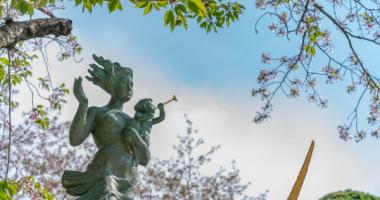
Crossing the bridge just south of the Atomic Dome and Mobilized Student's Memorial Tower brings you to the The Children's Peace Monument, erected in 1958 to remember child victims of the atomic bombing. The monument features millions of folded paper cranes and recalls the story of Sadako Sasaki, a young athlete who died of radiation-related illness but tried to cure her sickness by folding a thousand origami cranes. A statue of Sadako Sasaki holding a golden crane stands atop the monument.
This northern section of the Park also contains the Hiroshima Peace Bell, a large traditional Japanese bell which visitors to the Peace Park are encouraged to ring loudly for world peace; the Atomic Bomb Memorial Mound, modeled after a prehistoric Japanese burial mound, which contains the remains of 70,000 yet unidentified people who died in the bombing; and the Cenotaph For Korean Victims of The Atomic Bomb which honors the 20,000 Korean forced laborers who perished in August 1945. The Korean victims' memorial was dedicated in 1970, but was only allowed into the Peace Park in 1999 due to the continued friction between Koreans and Japanese over the events of World War II and Japan's pre-war colonization of the Korean peninsula.
Go a little further south and you come to the Memorial Cenotaph and Peace Flame located in the center of the island, forming a peaceful concrete and water garden monument to the city's A-bomb victims.
The Cenotaph, designed by Kenzo Tange, and its almost 100 meter long pond, are in a direct line with the Atomic Dome across the river. The Cenotpah is shaped like the clay saddles for figurines found in ancient tombs. Underneath its arch is a chest containing the names of those who died in the atomic bombing with the inscription: "Repose ye in peace, for the error shall not be repeated."
The nearby Peace Flame will remain alight until all nuclear bombs are decommissioned and the threat of another Hiroshima is over for ever. It is here that a memorial service is held on August 6 each year, when white doves are released.
Just to the east of the Pond, near the river, is the Hiroshima National Peace Memorial Hall for the Atomic Bomb Victims which is free to enter and contains a national archive of the names, photos, letters and memoirs of the victims. The building was commissioned by the national government in 2002 and designed by Kenzo Tange.
Address, timetable & access
Hiroshima Peace Park
-
Address
1-2 Nakajima-cho, Naka-ku
730-0811
Japan
-
Phone
+81 (0) 82 242 7798 -
Timetable
March 1 - July 31: 8:30 am - 6 pm
August 1 - 31: 8:30 am - 7 pm (until 8 pm on August 5 and 6)
Sepember 1 - November 30: 8:30 am - 6 pm
December 1 - February 28: 8:30 am - 5 pm -
Access
From Hiroshima Station, take tram lines 2 or 6 to Genbaku-Domu-mae Station -
Website
http://hpmmuseum.jp/