Nagasaki 長崎

JNTO

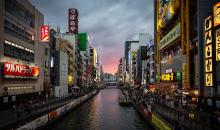
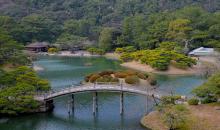
Le pont Megane
Pixabay

JNTO

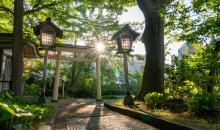
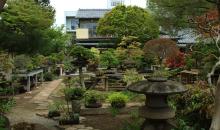
The Glover Garden of Nagasaki
JNTO

JNTO
Local Time 19:52
-
Symbol : cloudy_rainy
Temp : 21.3°C
Date : Today
-
Symbol : cloudy_rainy
Temp : 20°C
Date : Tomorrow
-
Symbol : sunny_cloudy
Temp : 20.7°C
Date : Tuesday
-
Symbol : cloudy
Temp : 17.9°C
Date : Wednesday
Nagasaki, a port city with international influences
A port nestled among steep hills, a long exchange with foreign countries, a quietly commemorated tragic background: welcome to Nagasaki, the most cosmopolitan and enjoyable city on Kyushu.
Nagasaki Travel Guide
Nagasaki is a small, hilly, port city on the west coast of Kyushu.
Nagasaki was founded in 607 A.D. Nagasaki's population is about 420,000. Historically, Nagasaki was Japan's window on the rest of the world, and pleasantly reflects that foreign influence even today, especially in its Dutch and Chinese architecture.
Nagasaki is also famous as the having been the second target of the atomic bomb in World War 2, when the city was attacked at 11.02am on August 9, 1945.
Nagasaki is easy to navigate on foot and by streetcar. Nagasaki's entertainment area is called Shianbashi with the main shopping area of the city located in Hamanomachi.
Famous sights in Nagasaki include its Chinatown, Glover Garden and Dejima Island. Nagasaki is only 90 minutes away from one of Japan's best theme parks, Huis Ten Bosch. Nagasaki Lantern Festival is a cultural highlight.
Nagasaki, a European city
Located in the south of the island of Kyushu , Nagasaki is the main city of the prefecture of the same name. This port city was founded in the 15th century by the Portuguese. It thus subsequently became an important port and point of commercial and cultural exchanges between Japan and Europe. It is therefore logical that Catholic missionaries arrived there on the archipelago in the 15th and 16th centuries. Part of the city's population was thus converted to Catholicism and many churches, still standing today, were built. However, in 1614, this religion was banned with the coming to power of the shogun Ieyasu Tokugawa, which gave rise to persecution.
Trade then slowed down during the Edo period (1603 - 1868), when the country was closed to the outside world. Only Dutch traders in the city, based on the small island of Dejima , have the right to continue international trade. Then, with the arrival of the Meiji era in 1868, the whole country resumed trade.
The ban on Catholicism was lifted in 1872: it was during this period that the Urakami Cathedral was built, today the largest in East Asia. Nagasaki then benefits from numerous exchanges with both Europe and China : many monuments from this period remain, such as Chinese temples and Confucian shrines, as well as many colonial-style houses .
The atomic bomb in Nagasaki, a city of peace
11:02 am: how can we not think about this fateful schedule when walking around Nagasaki? It was at this moment that the hands of the clocks froze on August 9, 1945 , when the second American atomic bomb exploded in Urakami .
This suburb of the northern hills of Nagasaki, residential and discreet, perpetuates the memory: at the point of impact is today the Peace Park , which adjoins the Atomic Bomb museum, captivating as well as moving, while 'nearby exceeds the green roof of the Sainte-Marie cathedral (where many faithful perished: the bomb was dropped during the service).


What to see in Nagasaki?
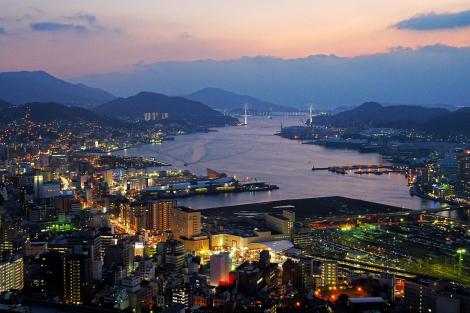
Built in a basin between mountains and the sea, Nagasaki remains a romantic and charming city . It is thus very pleasant to walk the Minamiyamate hill, where the old French consulate remains, transformed into a café, and in the Glover garden. This district allows you to immerse yourself in the atmosphere of Puccini's opera, "Madame Butterfly" , which takes place in Nagasaki in the 1920s ...
The southern climate of the city also makes it possible to enjoy the good weather whatever the season, alternating between old quarters and large modern avenues.
Here are the places and points of interest not to be missed if you are visiting the city :
-
The city view from Mount Inasa (via cable car) : Fuchimachi, 852-8012 Nagasaki
-
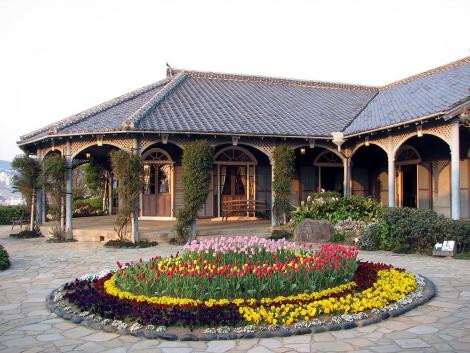
The 19th century colonial houses in Glover Garden , including the Glover House : 8-1 Minamiyamatemachi, 850-0931 Nagasaki
-
The surroundings of the Nakashima river and its stone bridges : Uonomachi, 850-0874 Nagasaki
-
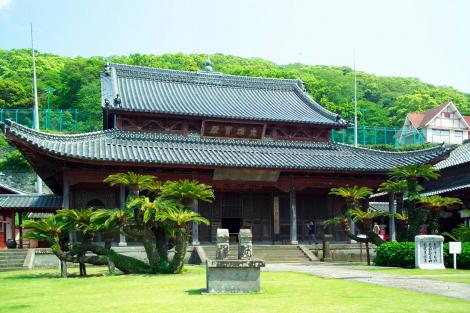
Kofukuji Temple and its splendid Japanese gardens : 4-32 Teramachi, 850-0872 Nagasaki
-
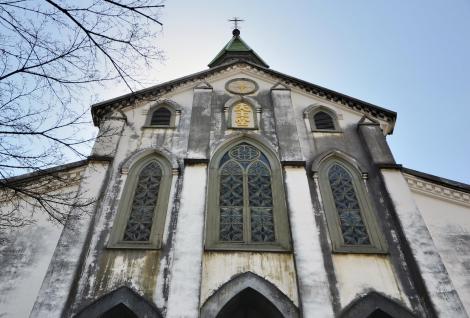
Oura Church : 5-3 Minamiyamatemachi, 850-0931 Nagasaki
-
Urakami Cathedral : 1-79 Motoomachi, 852-8112 Nagasaki
-
The old Dutch shopping district, Dejima : Dejima, 6-1 Dejimamachi, 850-0862 Nagasaki
-
Nagasaki Peace Park , commemorating the victims of the bomb: 9 Matsuyamamachi, 852-8118 Nagasaki
-
The Atomic Bomb Museum : 7-8 Hiranomachi, 852-8117 Nagasaki
-
The amazing abandoned mining island of Gunkanjima
-
Chinatown and its Confucian Shrine : 10-13 Shinchimachi, 850-0842 Nagasaki
To save money and get around Kyushu easily by train, consider getting an All Kyushu Area Pass.
Nagasaki Festivals
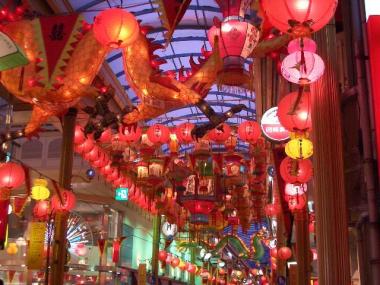
Nagasaki's main festivals include the Kunchi Matsuri in early October from 7-9th centered on Suwa Shrine and including Chinese dragon dances, fireworks (hanabi) and colorful costumes. The Nagasaki Lantern Festival in February celebrates Chinese New Year and the city's long history of foreign connections with China and Europe. The Shoro Nagashi Festival takes place on August 15 when hand-made floats are placed in the ocean at Nagasaki Harbor in a ceremony in honor of one's ancestors. From June to August the Nagasaki Dragon Boat Competition (Peiron Boat Races) features Chinese-style dragon boat races in the harbor and other venues in Nagasaki Prefecture. The main races take place on the last weekend of July in Nagasaki harbor in front of the Matsugae International Cruise Ship Terminal.
Nagasaki Entertainment
Nagasaki's main entertainment area is Shianbashi - the warren of narrow streets and arcades around Shianbashi tram stop: bars, restaurants, soaplands provide all night entertainment. The Nagasaki Dejima Wharf has a number of nice restaurants and cafes overlooking the harbor. The modern Nagasaki Prefectural Art Museum designed by architect Kengo Kuma is a stand-out building in this area. The Hamano-machi area, with the Kanko-dori and the Hamano-machi arcades, is ideal for shopping with the Hamaya Department Store also here.
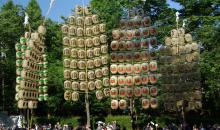
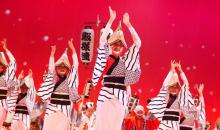
Le Festival des lanternes à Nagasaki
Wikimedia Commons

Nagasaki Kunchi, the Chinese dragon dance
Wikimedia Commons
Things to see and do in Nagasaki
Though Nagasaki had already been around for some 1000 years, the city's first real claim to fame dates to the 1550's (and then, of course, to the end of the war in August of 1945). In 1550 the first Portuguese ship arrived in Nagasaki Harbor. In 1571, the Japanese government opened up the port of Nagasaki to foreign trade to the Dutch and, to a lesser degree, Chinese.
The foreign traders were confined to tiny Dejima Island, first the Portuguese and then the Dutch after Portuguese traders were expelled. For more than 200 years this was Japan's only contact with the outside world. What remains of the city's experience with outsiders can be found in Chinatown, a reconstructed Dejima, castella (pound cake), the longer noses Nagasaki residents have supposedly been saddled with thanks to their Dutch genes, and more.
-
Dejima
This former man-made island is now part of the mainland of the city thanks to landfill. Dejima was a Dutch trading post to which the "hairy barbarians" were confined - and ordinary Japanese, except for courtesans provided to the Dutch, Japanese guards and Tokugawa officials, prohibited from entering - during Japan's two hundred years of self-imposed isolation (sakoku) from 1641 to 1854.
Dejima was the source of Rangaku, or Dutch learning, that became the basis of modern Japanese medicine and science. Much of Dejima is currently under construction now, but it is well worth seeing. Dejima is a short walk from Nagasaki's Chinatown.
The Siebold Memorial Museum is well worth a visit if you are interested in the early history of foreigners in Japan. Philipp Franz von Siebold was a German doctor who came to Japan with the Dutch and was resident physician on Dejima from 1823 -1829.
Siebold did much to introduce western medicine to Japan and introduce Japan to the west on his return to Europe. Take a #3 streetcar for Hotarujaya from Nagasaki Station and get off at Shinnakagawamachi and then a short walk.
-
Chinatown
Shinchi, Nagasaki's Chinatown, is a smaller version of the Chinatowns in Kobe and Yokohama complete with four ornate gates and packed with Chinese restaurants and shops.
Try Nagasaki's most famous dish champon: noodles served with shellfish, vegetables, and meat in a thick soup. (Champon reputedly comes from the Chinese for "Have you eaten yet?").
Chinese influence is not restricted to Chinatown alone. Sofukuji Temple dating from 1629 is an interesting place to visit for its imitations of Ming Dynasty architecture. Likewise Kofukuji Temple known as the "Chinese Temple" was established by the city's Chinese residents in the early seventeenth century. The Confucius Shrine was built in 1893 by Chinese residents to serve their religious needs and indeed the land still belongs to China and the title is administered by the Chinese embassy in Tokyo.
Two other temples in Nagasaki with a Chinese connection are Shofukuji and Fukusaiji.
Other temples in Nagasaki include Daikoji Temple, which dates from 1614. Hosshinji Temple contains Nagasaki's oldest bell, cast way back in 1438. Daionji Temple's cemetery has the grave of Matsudaira Zushonokami, the Tokugawa-appointed magistrate (bugyo) of Nagasaki, who in 1808 committed ritual suicide after the British frigate, HMS Phaeton, sailed into Nagasaki harbor. This intrusion led to the Tokugawa regime instructing its official interpreters to learn English and Russian, as well as Dutch, and in 1814, the first English-Japanese dictionary containing 6,000 words was compiled by the Dutch scholar Motoki Shozaemon. This incident is related in the novel The Thousand Autumns of Jacob de Zoet by David Mitchell.
Kotaiji Temple is another temple in Nagasaki's Teramachi area, an active Zen temple of the Soto sect, where foreigners are welcome to join meditation practice.
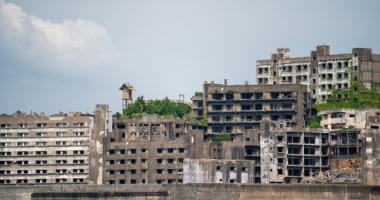
Since it opened to the public in April, 2009, the tiny uninhabited island of Hashima, located about 15km from Nagasaki, has quickly risen in popularity and is now one of the top tourist attractions of the city. More commonly known as Gunkanjima, Battleship Island in English, because seen from a distance the island resembles the shape of a battleship, Hashima is a ghost island with a post apocalyptic landscape of crumbling concrete and abandoned buildings that was once the most densely populated place on the planet.
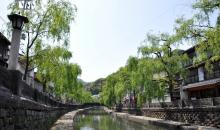
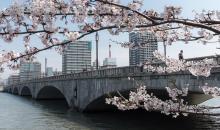
Meganebashi ("Spectacles Bridge") is the oldest foreign style bridge in Japan and lies south of the main station across the Nakajima River. The double arches of the stone bridge resemble spectacles when reflected in the water, hence the name.
The Nagasaki Lantern Festival is a must-see festival if you are in the area in late January and early February as the city celebrates Chinese New Year.
The Nagasaki Museum of History and Culture is not far from Suwa Shrine and is partly housed in a reconstruction of the Edo Period Nagasaki Magistrate's Office. The museum details Nagasaki's international exchange with China, Holland, Portugal, Spain and Korea and displays industrial arts and crafts produced in Nagasaki as a fruit of the city's international trade. Across the road is the free Museum for the Former Site of Santo Domingo Church - which exhibits the ruins of the Edo Period church of Santo Domingo. The remains of the church were discovered during building work on the Sakuramachi Elementary School next door.
The Kameyama Shachu Memorial Museum is a restoration of the building that housed a shipping company begun by Sakamoto Ryoma, a prominent activist in the struggles to overthrow the Tokugawa regime in the 1850's and 1860's. The museum is a 15-20 minute walk from the Kokaido-mae tram stop close to Kokufuji Temple.
-
Oura Catholic Church
Oura Catholic Church is Japan's oldest Gothic church built for the foreign community in the nineteenth century under the supervision of a French missionary, Petit Jean. The church is on the way to Glover House and is closely tied to the history of Japan's Hidden Christians (kakure kirishitan) who were persecuted, often martyred and forced into hiding by a Tokugawa government ban on Christianity.
In particular the church commemorates the martyrdom in 1597 of 26 Christians - 20 Japanese (including 3 young boys) and six foreigners (4 Spaniards, 1 Mexican and an Indian) - who were crucified and run through with spears in Nagasaki on the orders of Hideyoshi Toyotomi, Japan's military ruler at the time. The site of the actual incident is Nishizakamachi - a short walk from Nagasaki Station.
The monument below and adjacent Twenty-Six Martyrs Museum were completed in 1962. The museum has an excellent collection of historical artifacts relating to the introduction of Christianity in Japan including original statues of the Virgin Mary, disguised as Kannon, the Japanese goddess of mercy, and fumi-e, metal images of Jesus or Mary, that Christians were forced to stamp on to renounce their faith. The highlight of the museum is an original letter written by Francis Xavier to King John III of Portugal. The museum also covers the Hidden Christians (kakure kirishitan) who continued their faith in secret throughout the Edo Period.
-
Urakami Cathedral
This fine brick building and reputedly the largest church in the East is a replica of 1925 original destroyed by the atom bomb in 1945. You can still see scorch marks on some of the restored statues near the front entrance and the first belfry which collapsed into the church grounds and is preserved as a memorial. Urakami Cathedral was originally built to serve the many kakure kirishitan (Hidden Christians), who had retained a version of their faith during the times of persecution under the Tokugawa regime in the Edo Period of Japanese history (1603-1867). The original Urakami Cathedral was completed in 1925 and the building we see today dates from 1959.
-
Glover House
The inspiration for Puccini's Madame Butterfly, this mansion was built in 1863 by Scottish merchant Thomas Glover. Glover came to Japan at age 21 and never left. He worked in shipbuilding, coal, arms dealing and brewing, ultimately being awarded the Second Class Order of the Rising Sun. The Glover house and grounds sit atop a hill that commands a view of the entire city - and speak of a bygone era of fabulous luxury.
-
Dutch Slope
Close to Oura Catholic Church and the Confucian Shrine, is Orandazaka (Dutch Slope), a pleasant area with views of the bay. This district was settled by foreigners after Nagasaki opened as a Treat Port in 1859 and contains some attractive western-style, clapboard buildings preserved as museums, cafes or private residences.
-
Peace Park
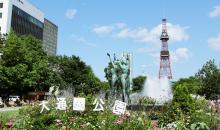
A trip to Nagasaki must include a ride out to Peace Park and the nearby Nagasaki Atomic Bomb Museum dedicated to the events of August 9th, 1945. Connected to the Atomic Bomb Museum is the impressive and moving Nagasaki National Peace Memorial Hall for the Atomic Bomb Victims with a registry of all the victims of the bombing kept in a solemn and beautiful, subterranean Remembrance Hall. Next to the Atomic Bomb Museum is the Nagasaki Museum of History and Folklore containing the Noguchi Yataro Art Museum. Peace Park is a few minutes walk away, and was the epicenter of the atomic bombing in 1945. Go up the stairs to the beautifully laid out garden, with its Peace Fountain, the famous Peace Statue, and with memorials for peace donated by several different countries, many of them from the former Eastern Bloc. Urakami Cathedral is only a short walk away up hill along with the Nagai Takashi Memorial Museum.
Access - Getting to Nagasaki
-
By Air
There are connections to Tokyo, Osaka, Kagoshima, Okinawa and other destinations from Nagasaki Airport. Nagasaki Airport is about 40km from the city center and buses take about an hour from outside Nagasaki Station.
-
By Train
From Nagasaki Station there are JR trains to Hakata Station in Fukuoka for Shinkansen connections to Yamaguchi, Hiroshima and Osaka, Kumamoto and trains to Oita. From Nagasaki to Kagoshima take a Kamome Limited Express bound for Fukuoka, and change at Shin-Tosu for the Kyushu Shinkansen. Journey time is about 3 hours. From Nagasaki to Hakata (Fukuoka) the Kamome Limited Express takes two hours. Nagasaki Station also serves local JR trains going to Isahaya, Omura, Huis Ten Bosch, Haiki and Sasebo as well as Kikitsu, Hizen-Yamaguchi, Saga, and Tosu.
-
By Bus
There are buses to Fukuoka and night services to Osaka and Nagoya from the Ken-ei Bus Terminal opposite Nagasaki Station on the other side of the road. Buses from Nagasaki to Miyazaki take 5 hours, 30 minutes and there are also buses to Sasebo, Huis Ten Bosch, Kumamoto, Kagoshima, Kita-Kyushu, Nagasaki Airport, Beppu and Oita. There is another bus terminal near Dejima with buses to Nagasaki Airport.
Local buses pull in just in front of Nagasaki Station and cost 150 yen within the city.
Nagasaki is an easy city to get around thanks to its excellent system of streetcars. Cycling is also possible and bicycles can be hired from a number of places. However, heading inland becomes decidedly hilly.
There are four lines, numbered 1-5 (#2 is missing) and each line is color-coded. To reach Glover House & Garden take the #5 (yellow) for Ishibashi (pictured right) and get off at the OuraTenshudoshita stop. To reach the A-Bomb Museum take streetcar #1 or #3 and get off at Matsuyamachi. The Nagasaki streetcars run from 6.30am to 11pm. Check the stops for last departure times. A single journey costs 120 yen or buy a day-pass for 500 yen from the Tourist Information Center in Nagasaki Station.
Places of Interest Near Nagasaki
Nagasaki makes for an ideal base to visit the historic island of Hirado to the north, which has a fine castle and a number of spectacular Christian churches.
Huis Ten Bosch theme park and the port city of Sasebo (famous for its giant-size Sasebo burgers) are on the way on the journey north to Hirado. Heading east are Unzen and Shimabara, from where visitors can take the car ferry to Kumamoto.
The Nishisonogi Peninsula has a rugged coastline with a route on either coastline as you travel north.
The Goto Islands (Five Islands) are in fact a chain of numerous islands, many of them uninhabited about 100km off the coast of Nagasaki. The islands are part of the Saikai National Park and are known for their remote white beaches and churches, as the area was a refuge for Christians fleeing persecution during Tokugawa times. The five main islands are Fukuejima, Hisakajima, Nakadorijima, Narushima and Wakamatsujima with Fukuejima the largest and most populated, having a port and airport. The red brick Dozaki Church on Fukuejima dates from 1908. Fukue is 1 hour, 25 minutes from Nagasaki by jetfoil (longer by car ferry) and there are also boats from Sasebo calling at Arikawa on Nakadorijima, Ojika Island and Ukujima. Flights from Fukuoka to Fukue Airport take 40 minutes.
Day Trips from Nagasaki
-
Huis Ten Bosch
When noted Japan scholar and author Alex Kerr - then resident in Kyoto - was asked to write an article for a Japanese magazine about a theme park in rural Nagasaki Prefecture that is a reconstruction of Holland, he expected the worst: another cheesy theme park full of group tours posing for pictures with a lame character.
After visiting Huis Ten Bosch, though, Kerr didn't want to leave and return to modern Kyoto. In Kerr's eyes, Huis Ten Bosch was everything that modern Japan was not: orderly, beautiful, quaint - perfect to the last detail. The theme park is spacious and lovely, with exhibits, decent restaurants, performances, brick buildings, cobblestone squares, windmills, and thousands and thousands of tulips.
All the themes of the city
Interested by Nagasaki
Discover other cities to explore