Ginkakuji Temple
Ginkakuji Temple (Silver Pavilion) 銀閣寺
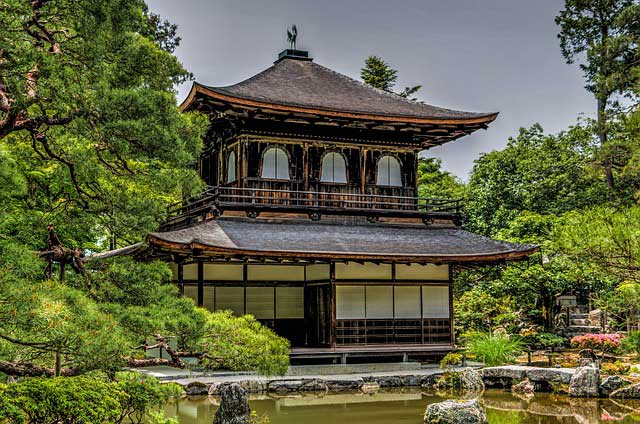
Ginkakuji
- A World Heritage Site.
- Located in northeast Kyoto.
- Exemplifies wabi sabi elegance.
- Not actually covered in silver leaf.
Ginkakuji, also known as Jishoji, is a Rinzai Zen temple in north-east Kyoto. Ginkakuji Temple is perhaps the pinnacle of the kind of Japanese aesthetic known as wabi sabi, typified by restraint, elegance and a sense of transience.
Best known for its stone gardens (the Sea of Silver Sand built to reflect the moon) and simple buildings, this fifteenth century temple was originally a villa for the artistic Shogun Ashikaga Yoshimasa, a poor, inept ruler in a time of conflict and instability, but a great patron of the arts: Noh theater, the tea ceremony and ikebana (flower arranging). Yoshimasa lived here from about 1484 until his death in 1490. In accordance with his wishes, it was then converted into a Buddhist temple.
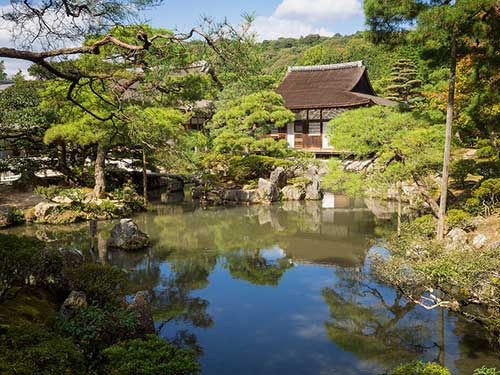
Ginkakuji Temple, Higashiyama, Kyoto
Located at the end/beginning of the Philosopher's Walk, Ginkakuji is discussed in detail in Donald Keene's book, Yoshimasa and the Silver Pavilion: The Creation of the Soul in Japan.
Ashikaga Yoshimasa, is said to have intended having the structure covered in silver leaf, in emulation of the gold-leaf covered Kinkakuji Temple of which his grandfather was the patron. However, the disruptions of the Onin War meant that this feature was never realized - the name alone lives on as witness to the intention. Another theory is that the "silver" refers to the reflection of the moon on the plain wood of the pavilion during moon-viewing parties, when sake would be drunk and poems composed by Yoshimasa and his friends.
The first storey was used as a residence, on the upper floor of the temple in the Buddhist altar room, or butsuma, is a gilded figure of Kannon (the Goddess of Mercy).
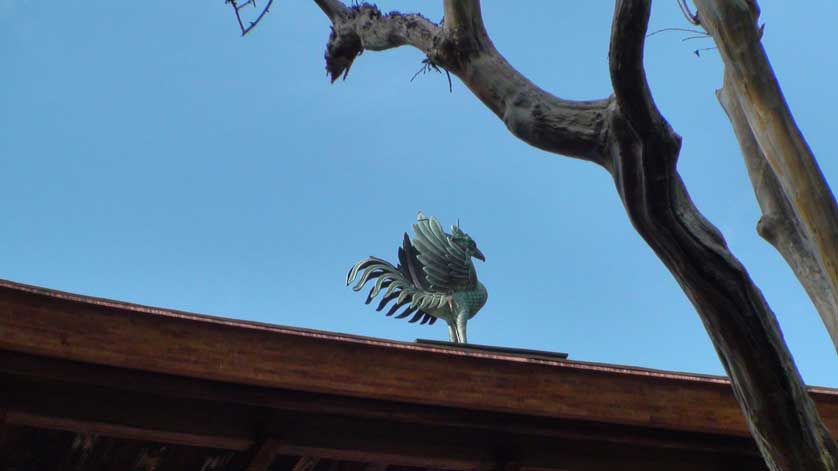
Mythical bird on the roof of Ginkakuji Temple
History of Ginkakuji Temple
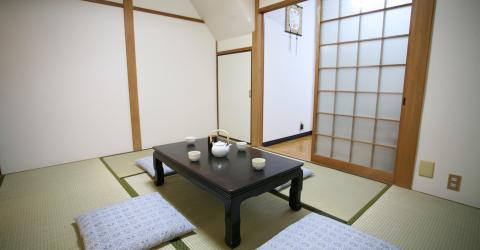
The Togu-do houses a tiny 4-and a half mat tatami room known as the Dojin-sai and designed by Murata Shuko (1423-1503). Said to be the oldest tearoom in Japan, its simple but classic design served as a model for many future tearooms.
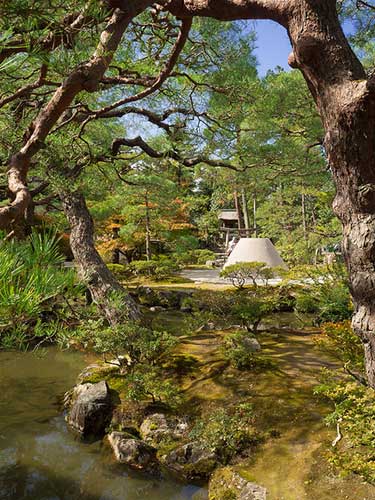
Ginkakuji Temple, Higashiyama, Kyoto
The Dojin-sai room contains a sunken hearth and tokonoma alcove. A small corridor leads from here to the Roseitei - reproductions of the rooms used by Yoshimasa for incense-burning ceremonies. The Main Hall or Butsuden (Hall of the Buddha) contains an image of Sakyamuni (the historical Buddha) but is closed to visitors.
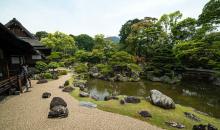
The stone gardens are thought to have been designed by master gardener Soami (1455-1525) and include a moss garden and a distinctive dry stone garden containing a large cone called the "Moon Viewing Platform" (kogetsudai) surrounded by an area of raked white sand representing a Chinese lake, called ginshadan. See photograph below.
The gardens are on two levels, as at Saihoji Temple, with the pond garden to be viewed from an upper garden.
Today Ginkakuji ranks with Kiyomizu Dera and Kinkakuji (Golden Pavilion) as one of the most visited sites in Kyoto.

View of the Silver Pavilion - Ginkakuji Temple - amongst summer leaves
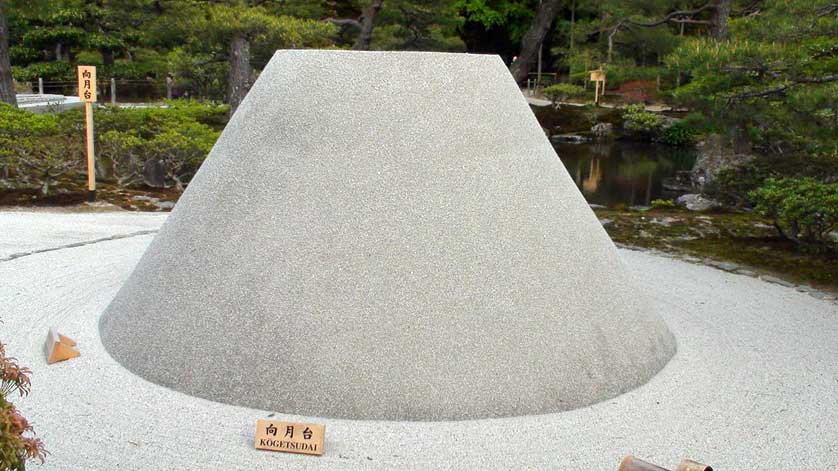
The "Moon Viewing Platform" (kogetsudai) at Ginkakuji Temple, eastern Kyoto
Ginkakuji Access
Keihan Demachiyanagi is the nearest station though a bus or taxi from there will save you a long walk, or alternatively take bus #5 from Kyoto Station, or the Raku Bus #102 or #100, also from Kyoto Station. Get off at the Ginkakuji-mae stop.
Ginkaku-ji is a short walk along the Philosopher's Path from Honen-in and can be combined with a visit to Nanzenji Temple to the south and the excellent Hakusasonso Hashimoto Kansetsu Garden & Museum on the approach road to Ginkakuji itself.
Ginkakuji Temple
2 Ginkaku-cho
Sakyo-ku
Kyoto.
Tel: 075 771 5725
Ginkakuji Hours and Admission
Ginkakuji is open from 8.30 am to 5.00 pm March through November, and 9.00 am to 4.30 pm December through February.
Admission to Ginkakuji is 500 yen for adults, and 300 yen for children up to junior high school age.
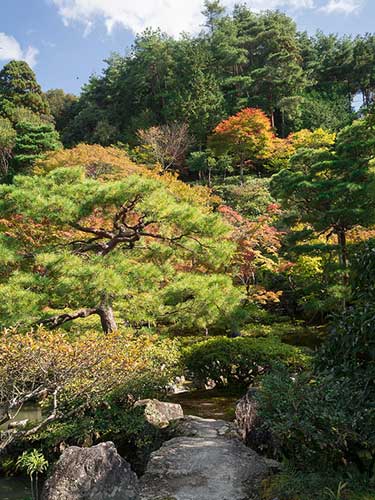
Ginkakuji Temple with autumn leaves
Bicycling along Philosopher's Walk is a good way to get to Ginkakuji, Anrakuji, Honen-in and Reikanji.
All these temples can be visited in half a day's sightseeing from your hotel in Kyoto.
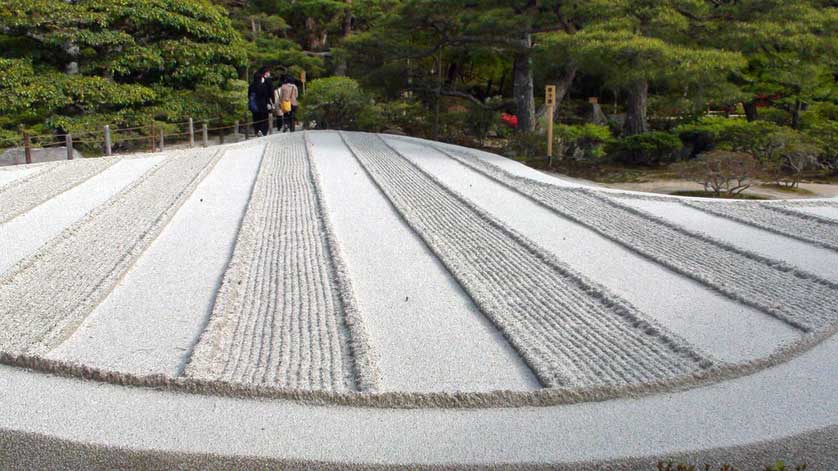
Raked white sand at Ashikaga Yoshimasa's delightful Ginkakuji
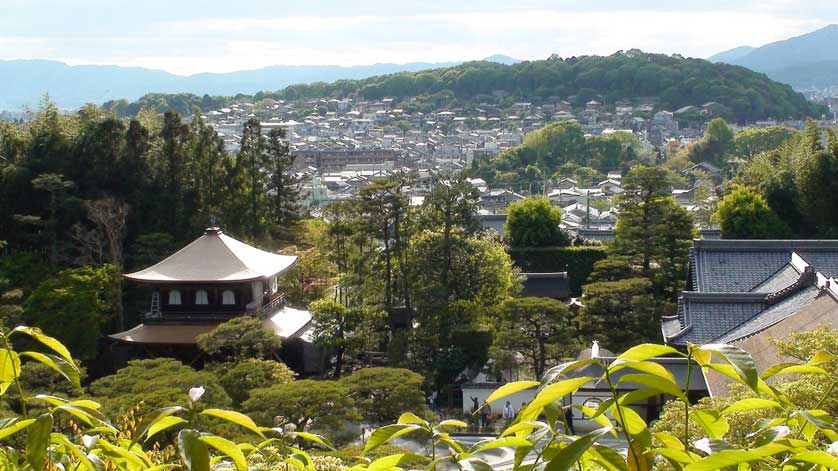
View overlooking Ginkakuji Temple
Ginkakuji Area Map
Books on Kyoto Japan
Ginkakuji Temple: read a guide to Ginkakuji Temple (Silver Temple) in Kyoto, formerly a villa for the artistic Shogun Ashikaga Yoshimasa.