Suwa Shrine Nagasaki
Suwa Shrine Nagasaki: Suwa Shrine is the premier shrine in Nagasaki and home to the Kunchi Festival.
Suwa Shrine 諏訪神社
Jake Davies
Suwa Shrine is the premier shrine in Nagasaki and home to the Kunchi Festival, one of the biggest festivals in Japan. The Nagasaki Suwa shrines' origin lie in a small shrine that was erected in 1619, the year that Tokugawa Ieyasu issued his edict against Christianity. These two events are closely related.
By the beginning of the 17th century the population of Nagasaki was predominantly Christian and during the latter half of the 16th century they had destroyed most of the Buddhist temples and Shinto shrines in the area.
History
Beginning with Hideyoshi in 1597, the successive rulers of Japan enacted increasingly harsh measures to suppress and eradicate Christianity which they had come to view as dangerous and a threat to their power, perhaps the most well known example of the persecution being the crucifixion in Nagasaki in 1597 of 26 Christians.
As part of the measures the bakufu attempted to rebuild the shrines and temples in the city, but, like the small, original shrine built in 1619, sabotage by the Christians slowed the imposition of Buddhism and Shinto.
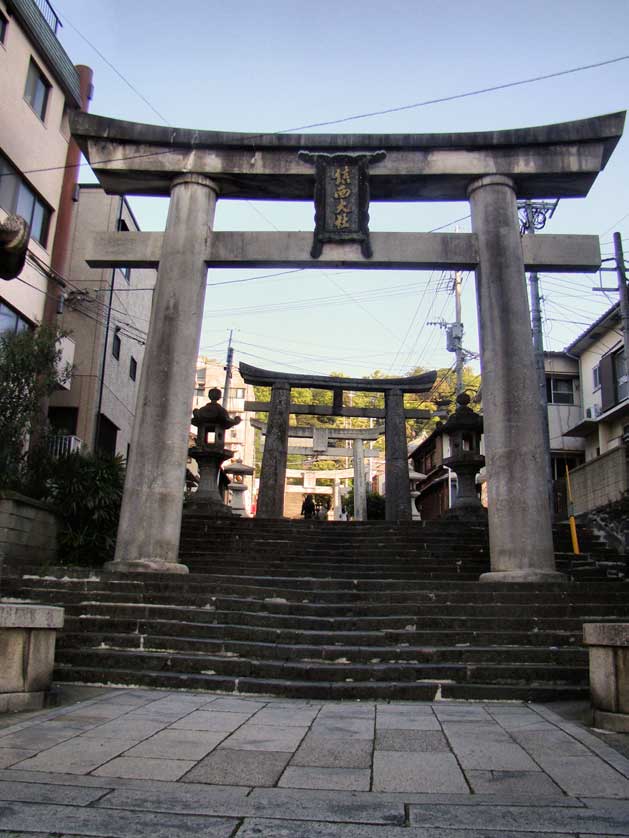 Torii gates leading to Suwa Shrine in Nagasaki
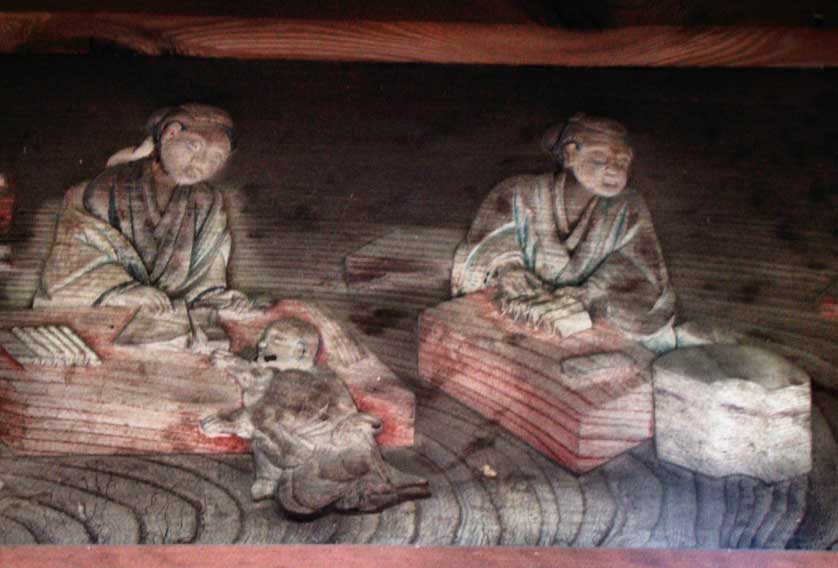 Relief carvings showing Nagasaki's citizens at work
Things began to change in 1623 with the arrival of Aoki Kensei, a yamabushi, the wandering mountain-ascetics that roamed and preached all over Japan.
There is no direct evidence that he worked for the shogunate, but he did receive funds from them, and as a measure of just how important the eradication of Christianity was, the shogunate only put money in to two shrines, one being the great mausoleum to the Tokugawa founder Ieyasu at Nikko, and the other the Suwa Shrine in Nagasaki.
Aoki, who was to become the first priest of Suwa Shrine, and his sons devoted themselves to establishing the shrine and eventually succeeded. Partly this may be due to bringing in a neighborhood festival to take place within the shrine. This became the Kunchi Matsuri.
Another measure was an edict forcing every resident to register as parishioners at the shrine. Failure to do so meant you were Christian and subject to punishment. Both of these methods, the enforced registration at a shrine and the incorporation of local festivals into the shrine were methods used more than two centuries later by the Meiji government in the establishment of State Shinto.
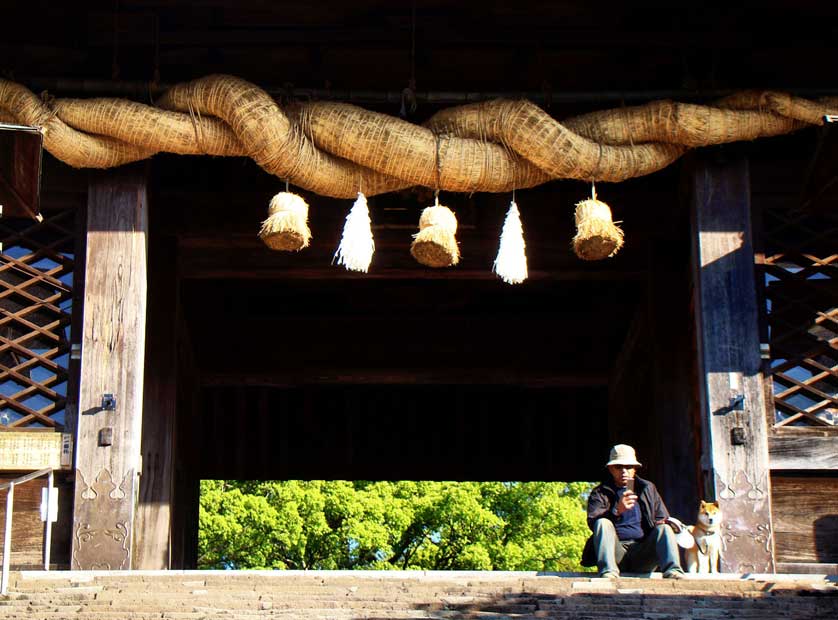 Shimenawa sacred rope at Suwa Shrine in Nagasaki
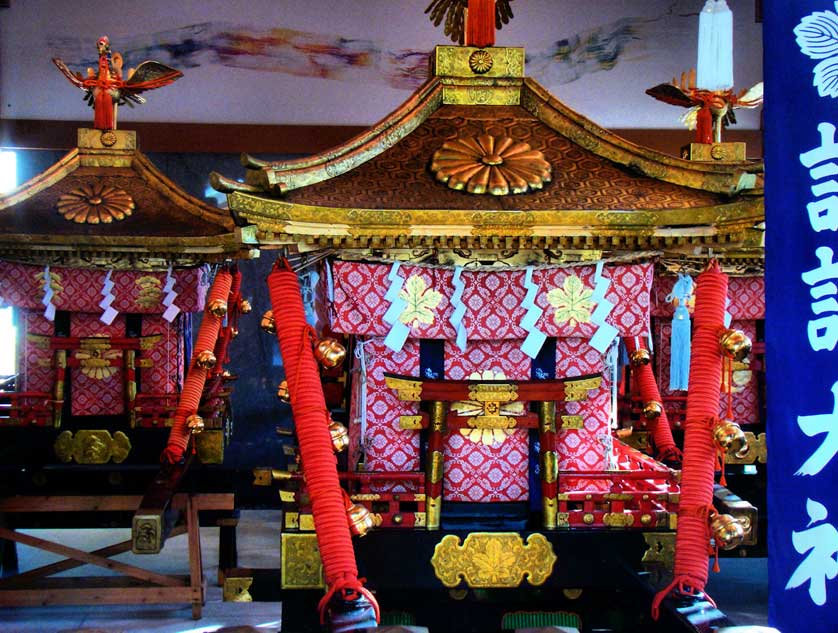 Mikoshi portable shrines at Suwa Shrine, Nagasaki
Today Suwa Shrine looks like many other major shrines in cities around Japan. Approached up a long flight of more than 250 stairs, flanked by torii and komainu, all the rituals and ceremonies now associated with shrines take place here: blessings of children and cars, purifications etc.
The komainu, guardian lion-dogs, are particularly interesting and especially diverse in style. There is a "money-doubling lion" that if you wash your money in the water coming out of its mouth it will double, but the most famous pair of komainu here are the "Stop Lions" by tying a thin strip of paper around the lion's leg one wishesfor success in stopping something - gambling, drinking, smoking etc.
On the way up the steps to the shrine, not far from the top, there is a lane on the right that leads to another shrine. This was the original site of Suwa Shrine, and is now a Tenmangu shrine. If you go through the shrine grounds, past the chickens roaming free, and look at the back, there is a wall surrounding the honden (main hall), and in the wooden fence atop the wall are a series of exquisite relief carvings. Traces of paint still remain but even in their unpainted state they are remarkably detailed and show the citizens of Nagasaki engaged in their various traditional crafts and trades.
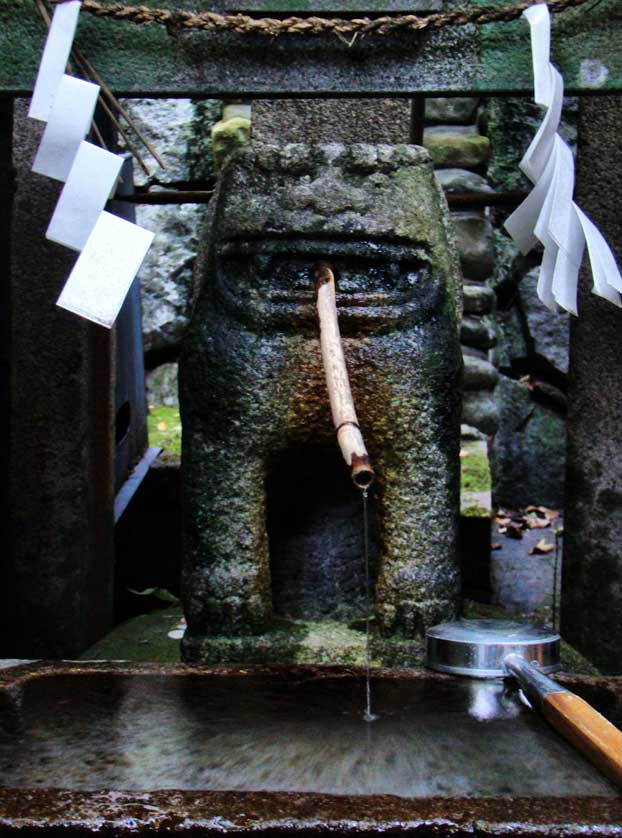 Chozuya at Suwa Shrine
The Kunchi Matsuri takes place from October 7th to the 9th each year and has grown to such a size that it takes place at several other locations other than Suwa Shrine.
One of the reasons for its popularity is that each year is different. A total of 59 different neighborhoods take part in the festival, but each neighborhood only takes part every 7 years, so from year to year the content of the events changes. There are various types of events, Kasaboko Procession are when each neighborhood proceed to the shrine headed by a kasaboko, a huge umbrella like object weighing upwards of 100 kg.
Each kasaboko is decorated to reflect its home neighborhood (odoricho). Honodori are traditional dances, often long epics accompanied by shamisen, including the Oranda Manzai which tells the story of the meeting between Dutchmen and geisha.
Hikimono are huge wheeled floats representing different kinds of boats associated with Nagasaki: Japanese, Dutch, and Portuguese. Katsugimono are a variety of heavy objects that are carried rather than wheeled and this includes such things as giant taiko drums as well as dragons etc.
Some of these events need tickets.
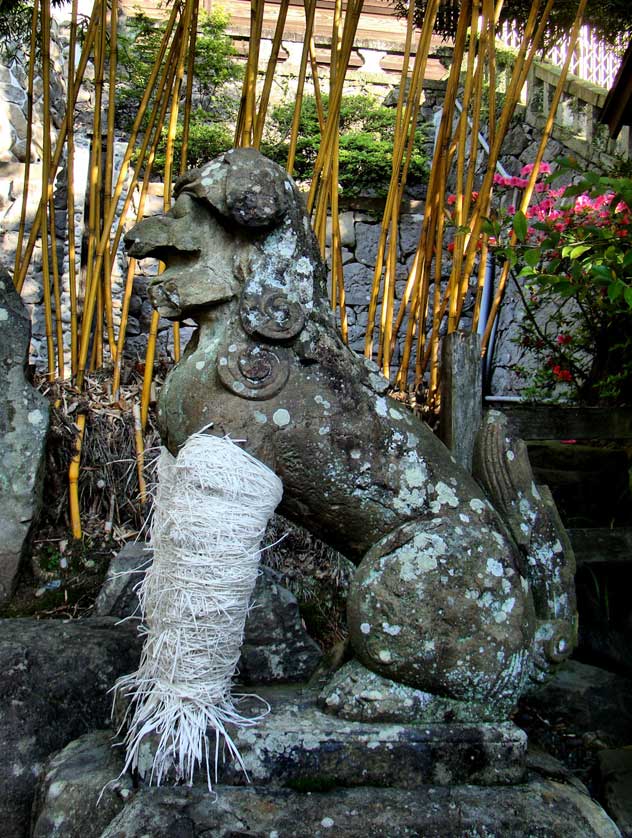 Stop Lion at Suwa Shrine
Access
Suwa Shrine
18-15 Kaminishiyamamachi
Nagasaki
Nagasaki Prefecture 850-0006
Tel: 095 824 0445
Suwa Shrine is best reached from the Suwajinja-mae stop on lines 3, 4 and 5 of the Nagasaki street car system.
Suwa Shrine in Nagasaki is one of the more than 10,000 Suwa shrines across Japan with the head shrine, Suwa Taisha located in Nagano Prefecture.


