| |||||||||||
| North Koreans in Japan |
A stronger Korean community didn't appear until around the time of the Second World War. The successive Japanese governments of Meiji, Taisho and Showa encouraged an image of Koreans as being inferior to Japanese, even though until the end of the war, Koreans were classed as Japanese citizens, albeit with a different family registration system.
By the end of the war, roughly 2,300,000 Koreans were living in Japan, and three-quarters of them returned to Korea. Just after the end of the war, Koreans residing in Japan were stripped of their Japanese citizenship, and in 1952 the Alien Registration Law was implemented.
The Korean community began to form schools with the intention of educating their children for an eventual return to Korea, but for most this did not happen. As the Korean War got underway, and the peninsula divided in two, so too did the Korean community in Japan, split along ideological lines.
With the normalization treaty of 1965 between Tokyo and Seoul, Korean residents in Japan became permanent residents. Since that time the issues of voting rights, citizenship, North/South Korean loyalties, inter-marriage, alien registration cards and identity formation have been of concern to many members of the resident Korean community.
Many Koreans refuse to naturalize, although they do have the option to do so. Without Japanese citizenship they are ineligible to vote. Many younger Koreans, unburdened by memories of the war and really only truly knowing Japanese culture and language, choose to naturalize.
Both younger Japanese and younger Koreans, especially the third/fourth/fifth generations of Korean residents, are not so political and less bothered by past issues.
The issue of voting rights is further complicated by the fact that the North Korean community opposes voting rights as they consider themselves to be foreigners in Japan and aligned with the motherland (North Korea).
The South-Korean affiliated organization (Mindan) is pushing for voting rights, and a bill has been brought up in the Diet several times but so far nothing has been decided. Those opposing the bill include the vocal Tokyo governor Ishihara Shintaro, who stated that voting rights should only be given to Japanese citizens. The bill has temporarily been shelved.
| Japan's Hidden Apartheid |
Inter-marriage between resident Koreans and Japanese is now very common, and it is commonly said that most young Japanese do not really care if their prospective spouse is a resident Korean.
If opposition comes at all it is usually from an older generation who still feel the legacy of history. There are still some historical issues that refuse to go away and these remain controversial.
The denial of pension rights to those Koreans forced to serve in the Japanese Imperial Army is one of them, and according to the Asahi Shimbun, in 2001 the Supreme Court threw out a case that involved a Korean man who had served in the Japanese Imperial Army and lived in Japan for 63 years but was still denied a pension.
Many Koreans use Japanese aliases, as they fear that their true identity cannot be revealed in certain situations, particularly in business. This is a personal choice and largely comes down to a mix of factors such as family history, affiliation with one of the residents' organizations such as Mindan or Chongryun (North Korea-affiliated), practicality, employment and degree of ethnic identification.
Many resident Koreans are prominent in the entertainment world; some choose to open about their ethnic background, others choose to hide it. Again, it is a personal choice based on a variety of factors.
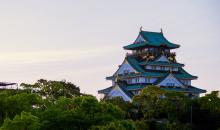
Osaka has the largest Korean community in Japan.
For those interested in reading more about the Korean community in Japan, as well as a vast amount of material available in Japanese, there are a number of good books in English that are available:
North Koreans in Japan, by Sonia Ryang
Japan's Hidden Apartheid, by George Hicks
Lives of Young Koreans in Japan, by Yasunori Fukuoka
Japan's Minorities, edited by Michael Weiner
A version of this article first appeared in Avenues: Voices of Central Japan magazine
Books on Japanese Politics | |||
|
| |||