Yabusame - Horseback Archery
Jiro Taylor visits a horseback archery festival in Koyama 流鏑馬
It's a warm, sunny autumn day in Koyama Town, in the heart of rural
Kagoshima prefecture.
Flanked on the south by steep, green hills, on the east by the Pacific
Ocean and to the north and west by endless fields and rice paddies, Koyama
is a place where the young leave and the old return to enjoy the serenity
of rural life.
I am in Koyama to watch the annual yabusame festival. The preeminent
scholars and practitioners of yabusame, the Takeda School, have traced
the roots of the ritual to as far back the year 530 A.D.
Legend has it that the 29th emperor, Kinmei prayed for peace and good
harvest, then mounted his horse and fired three arrows at targets from
his galloping steed.
In later years yabusame became an integral part of military training.
The Shogun Minamoto (1147-1199) was an aficionado of the art and tirelessly
studied and promoted yabusame. His government was based in Kamakura, and
there under his reign on September 16th 1187 began the most famous yabusame
festival, held every year at the Tsurugaoka Hachiman Shrine. Today, this
yabusame festival is still the biggest, although other smaller ceremonies
have sprung up all over Japan.
In Koyama, yabusame is the highlight of the year. The street running
through the town center is closed off to traffic and decked out with decorations.
The usual suspects of Japanese festival food stalls line the road, all
yelling for their share of the customers. By midmorning the yabusame procession
is parading through town in preparation for the main showdown at two o'clock.
Samurai guards lead the troupe, followed by three prancing, colorful dragons.
There are two men hidden in each dragon, one controlling the swaying body
while the other jerks the garish head from side to side, snapping the
jaws in time with the music.
The dragons perform their routine and then scan the crowd lining the
street for those willing to put their heads in the jaws, for good luck.
Sandwiched between the dragons and a marching band, trots the horse and
rider both meticulously adorned in a bright splash of colors. Every year
a student from the second grade of the local junior high school has the
honor of performing the ritual.
Parents pay about 00,000 for this honor, and the child spends years
in preparation. This year it is 14-year-old Daita sat atop the horse.
He is dressed in rich purple, and holding his back ramrod straight, hands
out in front of him clutching his bow and arrow. Through the thick white
makeup his face is set in serious concentration, revealing a nervous awareness
of his responsibility.
The procession continues and I make my way through the bustling crowds
of families - past staring kids and grinning grandmas. Down on the riverbank
there is a circus atmosphere. A small donkey is tethered next to a pen
containing a giant sea turtle, a scabby monkey, a parrot and various rodents.
Fearless Japanese children bustle around the animals taking turns to poke,
prod and stroke.
The yabusame procession arrives on the riverbank. The dragons prance
and snap their jaws, and the horse circles too close for the little donkey,
who bucks and brays, scattering children to their mothers thighs. Across
the path a queue has formed in front of a trailer. Staff hand out umbrellas
to waiting customers, while people exit the rear of the trailer, soaking
wet. My curiosity piqued I wander over to see what oddity this festival
has thrown up. It seems that people are queuing, and paying to spend a
few minutes in a room in which it is raining. I am amazed it rained
for real only yesterday.
By one o'clock, the crowds are gathering at the shrine and all
along the yabusame course, a narrow track about 250 meters long connecting
the main street and the shrine. One side of the track is closed off to
the public, and the three targets are spaced out at 70 meter intervals.
On the other side of the track, camera men lugging huge telescopic lenses
are jostling for position, clambering up step ladders for a better view.
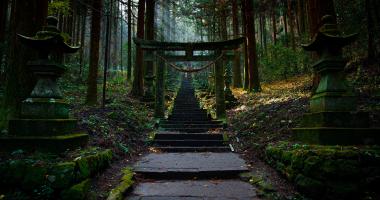
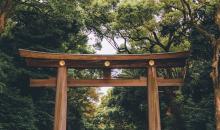
Throngs head to the shrine and crowd behind the torii gate to secure
prime vantage point all the way down the track. The atmosphere heats up
as the clock ticks closer to two. Right on time, the procession arrives
and polite applause ripples through the crowd.
The horse, rider and entourage slowly move up the track to the courtyard
in front of the gate where three priests are waiting. All around, people
vie to see what is happening. Packs of elderly women scramble up verges
to clutch trees, and children are hoisted onto shoulders. Daita bends
over to receive instructions, and arrows from the master of ceremonies,
while an aide pours confetti onto his helmet. His horse twitches and snorts,
sensing the tension in the air. One of the priests circles the courtyard,
scattering salt to purify the area from evil spirits. Daita shifts in
the saddle, locks his feet in the stirrups and readies his bow and arrow.
The moment has arrived. The horse is walked three times clockwise around
the circular courtyard. Then, as the crowd holds their breath, Daita digs
his hells into his horse's flanks, and leans forward yelling "Yah!
Yah!" The horse bursts into full gallop and hurtles down the track,
chased futilely by two of the entourage.
I see Daita unleash his first arrow on target, and then he is a blur
hidden by the crowds craning forward to watch from behind. It takes about
ten seconds during which time Daita has fired three arrows at consecutive
targets from his galloping steed. At the end of the track, Daita reins
in his horse, turns around and trots back to the courtyard for round two
of three.
All the ceremonial rituals are performed again, and over the loudspeakers,
the results are announced: two hits out of three. The crowds cheer in
hearty support and Daita readies himself for his next charge. By the end
of his final run, Daita has hit the targets with seven of his nine attempts
- last years archer managed six, the year before it was five. As Daita
trots back to the shrine, his work done, tears roll down his cheeks. I
hope they are tears of happiness, pride and relief.
With the ritual complete, the town is buzzing with activity as groups
prepare for the obligatory dance parade. The whiney music begins, and
the procession slowly winds its way through town. Some groups are dressed
in beautiful and bright traditional yukatas, and dancing with solemn
finesse.
Other groups are rowdy and dressed in all sorts from Doraemon to drag,
pouring shochu (local sweet potato
liquor) from the carton into each others open mouths. In their own way,
they are all having fun and enjoying the spirit of the festival.
I wonder if anything has changed since that first yabusame festival eight
centuries ago.
Text and Photos by Jiro Taylor
Japan Articles by Jiro Taylor
Zen Buddhism
Waribashi Chopsticks
Yabusame
Read about the Tsuwano Yabusame Festival
|